Orange County grout cleaning
Tile Cleaning Services and Grout Cleaning in Orange County, California
Certified for this work

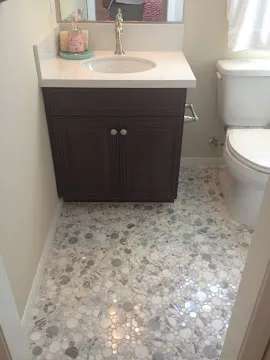
Grout cleaning is targeted extraction for the cement joints between your tiles, where most of the dirt actually lives. We pull years of cooking grease, foot traffic, and mop water residue out of grout pores with high-heat steam and vacuum recovery on floors and showers across Orange County.
Most calls come from homeowners in Tustin, Yorba Linda, and Newport Beach with 1990s and 2000s tile that has slowly turned dark on the kitchen aisle and gone black in the lower third of the master shower. The tile is fine. The grout is the problem.
years in construction and surface work
Google rating from local customers
California contractor license
Google reviews
Trust has to show up before the estimate.
5.0
Google rating from local customers
17
Google reviews and counting
Victoria
Orange County
★★★★★
"Our kitchen counter was pitted from water damage. Vince and Derrick fixed the granite and sealed everything at a reasonable price."
Google reviewJohn D.
Orange County
★★★★★
"Concrete patio, tile walkways, and driveway. Cleaning, patching, recoloring. Three days, and they aced it all."
Google reviewJudi Harris
Orange County
★★★★★
"Honest, hard working. Vince and Gio were punctual, neat, and surpassed our expectations."
Google reviewFrank Warren
Laguna Niguel
★★★★★
"Driveway was getting cloudy and chipping. Vince came out multiple times and even made a video showing me how to maintain it."
Google reviewMike Porter
Orange County
★★★★★
"Competitive quote, owner was hands-on the entire time, fixed every detail we pointed out."
Google reviewLaurie C.
Orange County
★★★★★
"Concrete restored and stained. Vince and his crew were professional, reliable, and always on time."
Google reviewMission Viejo location
Grout Cleaning from a local Orange County crew.
We are based at 23881 Via Fabricante, Suite 521 in Mission Viejo. Most grout cleaning work happens nearby in Lake Forest, Laguna Niguel, Rancho Santa Margarita, Irvine, Newport Beach, San Clemente, Tustin, and homes across Orange County.
Read the Google reviews on this page before you decide who should look at your surface.
What we do
Three reasons grout looks bad.
Embedded soil comes out with steam extraction. Mold and mildew need an oxygenated antimicrobial pretreatment before extraction. Permanent staining or pigment loss only color sealing can truly fix.
We use a turbo spinner head that delivers high-heat water at high pressure directly into the joints while a vacuum hose pulls the dirty water out in the same pass. Mopping just dilutes dirt and pushes it deeper into the pores.
The difference
Cleaning, color sealing, or regrouting.
Cracked, crumbling, or missing grout joints get repaired before sealing. Failing shower grout is a moisture problem first and a cosmetic problem second, because water gets behind the tile and rots the substrate.
We can regrout sections, switch you to epoxy grout in wet areas, or just clean and seal what is already in good shape. The walk-through tells us which combination your floor or shower needs.
Learn your surface
The better you understand the material, the better it holds up.
Quick reads on how grout cleaning actually works for orange county homes, before you spend money on the wrong fix.
High-heat steam extraction with vacuum recovery.
Antimicrobial pretreatment for shower grout.
Color sealing in any pigment shade.
Regrouting cracked or missing joints.
Epoxy grout conversion for wet areas.
Penetrating sealer over cleaned cement grout.
How we work
A clear plan before the machines come out.
01
Grout assessment
We walk every grout joint with a flashlight and check for embedded staining, mold, cracks, missing sections, and pigment loss. The walk-through tells us whether the floor needs cleaning, color sealing, regrouting, or some combination.
02
Pretreatment dwell
Stone-safe alkaline cleaner goes on kitchen and entry grout. Antimicrobial oxygenated cleaner goes on shower and wet-area grout to kill mold at the root. Both dwell long enough to break down embedded soil before extraction.
03
Steam extraction
The turbo spinner head pushes high-heat water at high pressure into the grout while vacuum-recovering the slurry. We work in small sections so nothing sits and re-soils. Cracked or missing grout joints get repaired with color-matched material before the next step.
04
Seal or color seal
Cement grout that came back to its original color gets a penetrating impregnator sealer. Permanently stained grout gets color sealed with a pigmented epoxy coating in your chosen shade, which also waterproofs the joint.
Orange County homes
Grout cleaning for Orange County homes.
Tract homes in Tustin, Orange, and Fullerton from earlier eras usually have sand-color or off-white grout that has soaked up years of cooking residue and mop water. After extraction the joints come back several shades lighter, and clients are surprised it was ever supposed to be that color.
Coastal showers in Laguna Beach, Newport Beach, and Huntington Beach grow mold faster because marine humidity keeps bathrooms damp longer. HOA-managed properties in Aliso Viejo, Ladera Ranch, and Rancho Santa Margarita schedule annual grout cleaning on common-area pool baths, lobbies, and clubhouse floors.

Questions
Straight answers before the estimate.
What is color sealing and when do I need it?
Color sealing is a pigmented epoxy coating applied directly to grout joints in any color you pick. It locks in a uniform shade and waterproofs the joint. You need it when cleaning alone won't bring the grout back, usually because of permanent staining or pigment loss. We test a small area first so you can see the color before we commit.
How long does grout sealing actually last?
A penetrating impregnator sealer lasts a few years on floor grout, less in showers and kitchens that get heavy moisture and cleaner exposure. Color sealing lasts longer because it's a coating on top of the grout, not just an absorbed sealer. We recommend resealing floor grout on a regular interval as cheap insurance against the next deep stain.
Can you fix cracked, crumbling, or missing grout?
Yes. Damaged grout gets removed with an oscillating tool and refilled with color-matched cement or epoxy grout depending on the location. Wet areas like shower floors and walls we recommend switching to epoxy grout because it doesn't absorb moisture or grow mold the way cement grout does. We do the regrout before any cleaning or sealing so the whole floor finishes uniformly.
What about mold in shower grout?
Most surface mold lifts out with our antimicrobial pretreatment plus steam extraction. Deep mold that has penetrated below the visible joint may have already gotten into the substrate behind the tile, in which case the grout has to come out and the area gets inspected for water damage. We tell you which situation you have during the walk-through, and either way the visible black goes away.
Why does my grout get dirty so fast after I clean it?
Two reasons. First, household mops just push dirt around and a lot of it ends up in the grout joints, which sit lower than the tile surface. Second, if the grout has never been sealed or the sealer has worn off, the cement is essentially a sponge that absorbs whatever liquid hits it. Professional cleaning plus a fresh sealer breaks the cycle, and after that, regular mopping actually keeps the floor looking clean.
Should I switch from cement grout to epoxy grout?
For showers and other constantly wet areas, usually yes. Epoxy grout doesn't absorb water, doesn't grow mold, and doesn't need sealing. For kitchen and entry floors it's optional, cement grout works fine if it's sealed and maintained. Epoxy is harder to install, costs more, and has a learning curve, so we only recommend it where the moisture problem actually justifies the upgrade.
Will the cleaning damage my tile?
No. Glazed ceramic and porcelain tile are not affected by the steam, pressure, or chemistry we use. Natural stone tile gets pH-neutral chemistry instead of the alkaline cleaner we use on porcelain, because acidic or strongly alkaline products can etch stone. The walk-through identifies which tile you have so we match the process to the surface.
Related
Other tile cleaning services in Orange County.
Tile Cleaning
Pool Tile Cleaning
Pool tile cleaning in Orange County, California for waterline tile, spa tile, coping, and the stone around the pool. We pull the calcium and hard water scale off the tile without scratching the glaze.
Tile Cleaning
Stone Tile Cleaning
Stone tile cleaning in Orange County, California for travertine, marble, limestone, slate, saltillo, granite, and grout. Cleaning, sealing, and restoration tuned to the stone.
Have a grout cleaning project you are not sure about?
Send a photo. We will tell you what we see and whether it belongs on our schedule.