Q: Do I need to replace my concrete or can it be repaired?
If the slab is structurally sound and the failures are localized, repair is the right call and usually one-third the cost of replacement. If you have widespread surface scaling, severe alligator cracking, or the slab has broken into separate pieces with significant elevation differences, replacement starts to make more sense. We tell you honestly which situation you are in. Most of what we get called out for in OC is repairable.
Q: Will the repair be invisible?
Close, not perfect. Color-matched patches and hand-texturing get within a shade or two of aged concrete, but a fresh repair on a 30-year-old driveway will always show as a slightly different tone for the first year or two until UV evens it out. If you want a fully uniform appearance, we can pair the repair with a stain or a thin overlay that hides everything under one consistent finish.
Q: What is the difference between mudjacking and polyjacking?
Both lift sunken slabs back to grade. Mudjacking pumps a heavy sand-cement slurry through penny-sized holes and adds weight, which can be a problem on already-failing soil. Polyjacking injects expanding two-part polyurethane foam through dime-sized holes, weighs almost nothing, cures in 15 minutes, and does not wash out. We use polyjacking on most residential work because the holes are smaller and the slab is drivable the same day.
Q: How long do concrete repairs last?
Epoxy-injected non-moving cracks are a permanent structural fix. Polyurethane-sealed working cracks last 8 to 15 years before the sealant needs to be redone. Polymer-modified mortar patches on spalls last 10 to 20 years if the underlying rebar is treated for corrosion. Polyjacked slabs hold their lift indefinitely as long as the original soil failure does not continue. We warranty our repair work for three years.
Q: Can you fix pool deck spalling?
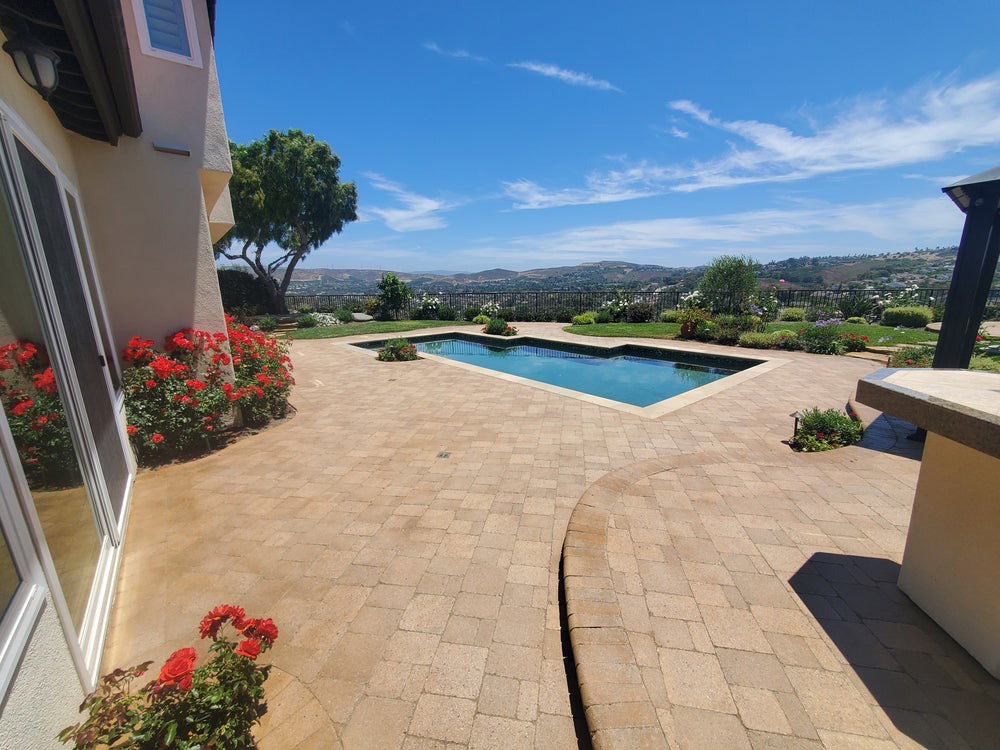
Yes, and it is one of the most common coastal OC calls. The fix is to chip out the loose surface concrete, treat any exposed rebar with a corrosion inhibitor like Sika FerroGard, prime the area with a bonding slurry, and rebuild the surface with a polymer-modified mortar rated for wet environments. After cure, we apply a chloride-resistant sealer. Skipping the rebar treatment is the biggest mistake we see on previous DIY or handyman repairs.
Q: How long before I can drive on the repair?
Most polyurethane crack sealant and polyjacking work is drivable within 30 minutes to 2 hours. Polymer-modified spall repair mortars are walkable in 4 to 6 hours and drivable in 24 hours. If you need a faster turnaround for a commercial property, we can use rapid-set products that are drivable in 90 minutes for an upcharge. We tell you the cure window before we start so you can plan.
Q: Do you handle expansion joint replacement?
Yes. Failed expansion joint caulk lets water down to the subgrade and is the leading cause of slab edge spalling in OC. We pull the old caulk with a joint plow, vacuum the joint clean, install closed-cell backer rod sized to the joint width, and refill with self-leveling polyurethane sealant in a color that blends with your concrete. Most homes have 30 to 80 linear feet of joints in driveway and walkway runs.
 Crack Repair (Epoxy Injection)