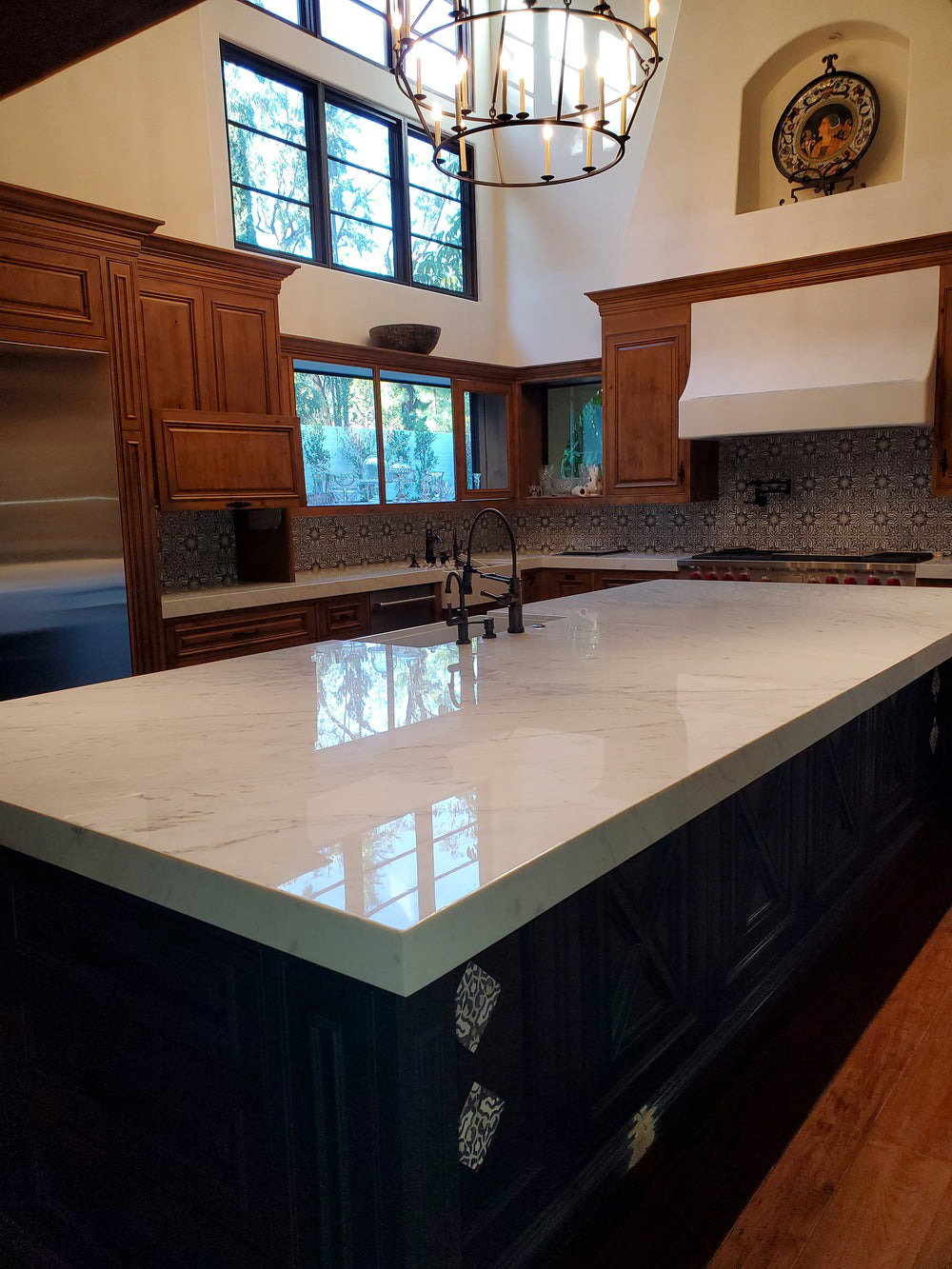
Orange County countertop color staining
Floor Polishing Services and Countertop Color Staining in Orange County, California
Countertop color staining and stain removal pulls wine, oil, coffee, rust, and hard water rings out of marble and granite counters in Orange County. Stains in natural stone are absorption problems, not cleaning problems.
We draw stains out with poultice work, repair acid etching with diamond honing, and reseal so the next spill stays on the surface.
years in construction and surface work
Google rating from local customers
California contractor license
Google reviews
Trust has to show up before the estimate.
5.0
Google rating from local customers
17
Google reviews and counting
Victoria
Orange County
★★★★★
"Our kitchen counter was pitted from water damage. Vince and Derrick fixed the granite and sealed everything at a reasonable price."
Google reviewJohn D.
Orange County
★★★★★
"Concrete patio, tile walkways, and driveway. Cleaning, patching, recoloring. Three days, and they aced it all."
Google reviewJudi Harris
Orange County
★★★★★
"Honest, hard working. Vince and Gio were punctual, neat, and surpassed our expectations."
Google reviewFrank Warren
Laguna Niguel
★★★★★
"Driveway was getting cloudy and chipping. Vince came out multiple times and even made a video showing me how to maintain it."
Google reviewMike Porter
Orange County
★★★★★
"Competitive quote, owner was hands-on the entire time, fixed every detail we pointed out."
Google reviewLaurie C.
Orange County
★★★★★
"Concrete restored and stained. Vince and his crew were professional, reliable, and always on time."
Google reviewMission Viejo location
Countertop Stain Removal from a local Orange County crew.
We are based at 23881 Via Fabricante, Suite 521 in Mission Viejo. Most countertop stain removal work happens nearby in Lake Forest, Laguna Niguel, Rancho Santa Margarita, Irvine, Newport Beach, San Clemente, Tustin, and homes across Orange County.
Read the Google reviews on this page before you decide who should look at your surface.
What we do
Reverse capillary action, not surface scrubbing.
Marble, granite, travertine, and limestone are porous. When wine or oil sits on the surface for a few minutes, the liquid soaks into the pores and a regular wipe-down cannot reach it.
A poultice is an absorbent paste mixed with the right solvent for the stain type. It sits 24 to 48 hours and pulls the stain back up out of the stone the same way it went in.
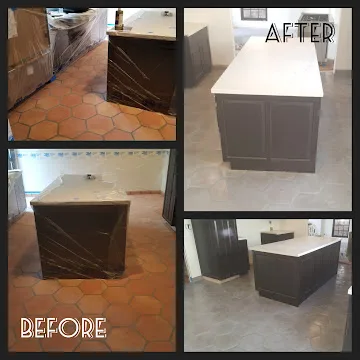
The difference
Wine, oil, rust, hard water, and acid etching.
Each stain type needs a different poultice solvent. Hydrogen peroxide for organic stains, acetone for oil and grease, oxalic acid for rust, bleach for biological.
Etch marks are a separate problem. Acid has eaten the polished surface, so we hone with diamond pads and re-polish to match the surrounding finish.
Learn your surface
The better you understand the material, the better it holds up.
Quick reads on how countertop stain removal actually works for orange county homes, before you spend money on the wrong fix.
Red wine spilled on a marble island
Olive oil ring on a Carrara counter
Cast-iron rust on a granite slab
Hard water haze around the faucet
Coffee or tea rings on light stone
Etch marks from citrus or vinegar
How we work
A clear plan before the machines come out.
01
Identify the stain type
We test the stain to determine if it is organic (wine, coffee, food), oil-based (olive oil, butter, grease), metallic (rust, ink), or biological (mildew). Each type needs a different poultice solvent. Misdiagnosis is the most common reason DIY stain removal fails.
02
Apply matched poultice
An absorbent paste mixed with the correct solvent gets troweled on 1/4 inch thick over the stain, covered with plastic and taped at the edges. It sits 24 to 48 hours, drawing the stain up into the paste as it dries. We may repeat once or twice for deep stains.
03
Repair etching if present
If the stained area also has acid etching, we hone the surface with diamond pads (200 to 800 grit on marble, finer on polished granite) until the etch depth is removed. We re-polish back to match the surrounding finish. Most etch repair is invisible to the original installer.
04
Reseal and hand off
Once the stain is gone and the surface is restored, we apply a penetrating impregnating sealer (typically 511 Impregnator or MB Stone Sealer) that buys long-lasting spill protection. We leave you a list of cleaners to use and a list to avoid.
Orange County homes
Countertop staining work for Orange County kitchens and baths.
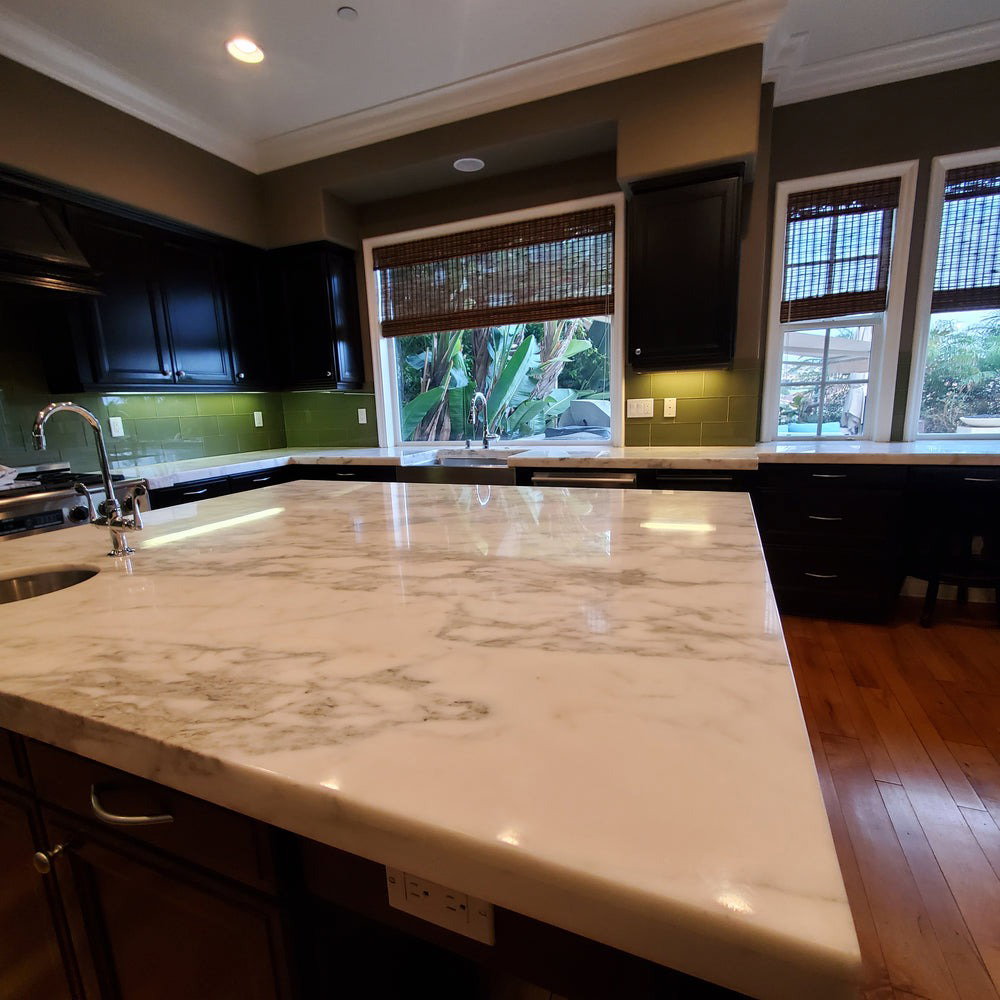
Carrara and Calacatta islands in Newport Beach and Pelican Hill, Crema Marfil counters in Coto de Caza and Anaheim Hills, and Calacatta Gold in newer Irvine and Ladera Ranch builds. All calcium-based, all stainable.
Hard water mineral rings show up on every stone type after a few years. Inland water in Anaheim Hills, Yorba Linda, and Brea is harder than coastal water and the rings build up faster.
Questions
Straight answers before the estimate.
Can you really remove a wine stain from marble?
Most of the time, yes. Red wine is an organic stain, which means a hydrogen-peroxide poultice will draw it out as long as the wine has not been sitting in the stone for too long. Fresh stains usually clear in one poultice cycle. Stains that have been there for years sometimes leave a faint shadow even after multiple poultice cycles. We tell you up front what we expect.
What is the difference between a stain and an etch?
A stain is discoloration in the pores of the stone, the surface is still smooth and reflective, you just see a darker spot. An etch is physical damage where acid has eaten away the polished surface, leaving a dull or rough patch that catches the light differently. Stains get pulled out with poultice. Etches get honed and repolished. A good share of the calls we get for stains are actually etches.
Will the poultice damage my marble or granite?
No. Poultice paste is designed to draw out stains without affecting the stone itself. The solvents we use (hydrogen peroxide, acetone, oxalic acid) are matched to the stone type and tested on a hidden area first. The only risk is using the wrong solvent on the wrong stone, like using an acid-based rust remover on marble, which would etch it. We avoid that by identifying the stone and the stain before mixing the poultice.
Can I remove the stain myself with a DIY poultice?
For a single small stain, yes, if you identify the stain type correctly and use the matching solvent. Plenty of online guides walk through it. The two most common DIY mistakes are using the wrong solvent (which either does nothing or etches the stone) and pulling the poultice off too early before it has fully dried, which leaves the stain in place. For a single oil drop on a vanity, give it a try. For a wine spill on a Calacatta island, call us before you experiment.
How do I get hard water rings off the stone around my faucet?
Hard water rings are mineral deposits, mostly calcium and magnesium, that bond to the stone surface. On granite and quartzite we use a stone-safe limescale remover with a non-acidic chelating agent. On marble and limestone we use a soft abrasive plus a polishing compound, since acidic limescale removers etch calcium-based stone. After removal we re-seal and recommend wiping the area dry after use to slow the next round of buildup.
What about old stains that have been there for years?
Older stains are harder to draw out because the staining material has fully bonded to the stone. We still try poultice first, sometimes with two or three cycles. If poultice does not fully clear the stain, we have two options: live with a faint remaining shadow, or hone down the surface a small amount and re-polish, which removes the top fraction of the stone where the stain is bonded. The second option is more involved but works on stains that poultice alone cannot fix.
How do I keep stains from coming back?
Reseal on a regular interval with an impregnating sealer (511 Impregnator, MB Stone Sealer, or similar). Wipe spills quickly, especially anything acidic (wine, citrus, vinegar, tomato sauce) or oily (olive oil, salad dressing). Avoid Windex, vinegar, lemon juice, magic erasers, and any cleaner not labeled stone-safe. Use cutting boards and trivets. We leave you a fridge-magnet card with the cleaners to use and the cleaners to avoid after every job.
Related
Other floor sanding & polishing services in Orange County.
Floor Sanding & Polishing
Concrete Polishing
Concrete polishing in Orange County, California for garages, homes, retail floors, offices, and warehouses. Diamond-honed concrete with a finish that holds up to real use.
Floor Sanding & Polishing
Marble Polishing
Marble polishing in Orange County, California for floors, counters, showers, and stone surfaces. Cleaning, honing, polishing, and sealing that bring marble back.
Floor Sanding & Polishing
Granite Polishing
Granite polishing in Orange County, California for kitchen counters, bath vanities, and stone floors. Restore shine and protect the surface against daily use.
Floor Sanding & Polishing
Travertine Polishing
Travertine polishing in Orange County, California for floors, showers, patios, and pool decks. Honing, cleaning, hole filling, and sealing for stone that takes daily use.
Floor Sanding & Polishing
Countertop Polishing
Countertop polishing in Orange County, California for granite, marble, quartzite, travertine, and natural stone counters. Refresh counters without replacement.
Floor Sanding & Polishing
Natural Stone Polishing
Natural stone polishing in Orange County, California for marble, granite, travertine, and limestone surfaces. Honing, polishing, and sealing tuned to the stone.
Floor Sanding & Polishing
Satin Finish
Satin finish floors in Orange County, California for marble, concrete, and natural stone. A soft sheen that reads finished without the slippery look of full gloss.
Have a countertop stain removal project you are not sure about?
Send a photo. We will tell you what we see and whether it belongs on our schedule.